
Open up ten B2B websites in your category right now. I’d bet eight of them say a version of the same thing. “We help companies grow.” “Trusted by industry leaders.” “The smarter way to manage your pipeline.” Swap the logos and you couldn’t tell them apart.
That sameness used to be survivable. It isn’t anymore.
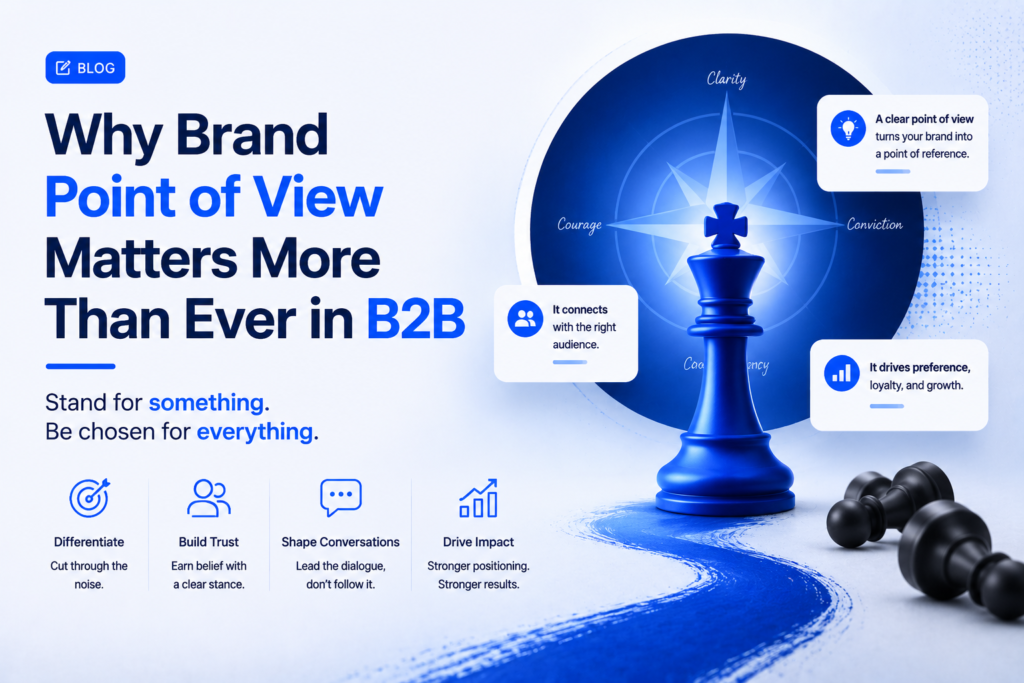
A point of view is the thing that breaks the tie. Not a tagline. Not a mission statement nobody outside the company has read. A real brand POV is a position you’re willing to defend in a sales call, on a conference panel, and in front of a skeptical board. It says how you see the market and where you think everyone else has it wrong.
Most B2B companies don’t have one. They have messaging. Those are not the same thing.
Messaging describes you. A point of view picks a side.
Messaging answers “what do we do.” A point of view answers “what do we believe, and who are we willing to annoy by saying it out loud.”
Take demand generation. The safe version reads “we drive qualified pipeline through multi-channel campaigns.” Fine. Forgettable. The POV version sounds more like: most of your MQLs are people who grabbed a free guide and will never buy, so stop chasing lead volume and start concentrating on the handful of accounts that can actually move your number.
One of those gets a polite nod. The other gets argued about and remembered. And memory is the whole game in B2B, which leads to some uncomfortable math.
The buyer isn’t in the room when they decide
LinkedIn’s B2B Institute helped popularize a finding from the Ehrenberg-Bass Institute that is worth putting on your wall: only about 5% of your potential buyers are actually in-market at any moment. The other 95% are not going to buy anything today. Maybe in six months. Maybe never.
So the real question isn’t “how do I convert the person reading this.” It’s “what do I want lodged in their head for the next two years, until the day they’re finally ready.” Generic messaging leaves no trace. A sharp position does.
Gartner has reported that B2B buyers spend only about 17% of their purchase journey talking to potential suppliers, and that portion gets even smaller when several vendors are competing. By the time someone schedules a meeting with your team, they have already formed opinions that you didn’t have a chance to influence. Your point of view is what molds those opinions when you are not there.
And, this is exactly where a firm decision without any noise can unintentionally do the sales’ task of convincing the buyer for it. A genuine standpoint narrows down the audience effectively on the market. The customers who disagree with your point of view choose to exit the conversation at the earliest stage, which is usually seen as a loss until the time when you experience the failure of enough deals that were terminated in the 4th month just because the buyer never really bought the premise of the first deal.
Those who have been already persuaded by you come to the initial negotiation half-way convinced. In fact, that is brand differentiation that does actual revenue work and not just sitting in a slide showing.
AI repeats back your brand to the people now.
Here’s the more recent reason why this is so important, and the one I’d see most closely if I were trying to figure out the next two years. Researches of buyers now are starting with posing a question to AI assistant rather than typing in Google. For example, they ask “What is the best approach to account-based marketing for mid-market SaaS?” and “Who are the credible players in B2B demand generation?” The model responds by a synthesis of what it has read on the Internet, and it often relies on sources that are the most specific and clearly the most authoritative ones.
Unclear and vague brands are not cited as they have nothing worth quoting.
Such are the brands that have been shooting the same hedged, everyone-already-agrees style of content as the other ten competitors since they hand the language model with nothing to be able to attribute. A very clear, repeatedly well-argued position, Then again, gives quotes that the language model can confidently use. What comes next is a silent but impactful reason why smart appearance to people is no longer the finish line of B2B thought leadership: you have to be so distinctive that a machine can correctly reproduce you.
That is also the very reason why the most powerful account-based and demand generation programs at the moment start with a position, instead of a channel plan.
How do you uncover your own position without seeming like everyone else?
These are a couple of things that worked and have been learned after doing this than just reading about it.
What would you be willing to defend in front of a table full of family members? If your company founder tends to get really engaged in a discussion about something in your sector, that is usually the initial spark of a genuine position. Conviction brings the best B2B brand strategy, not a whiteboard exercise.
Make a judgment on your willingness to let go of certain people. Naturally, you cannot be the go-to choice for everyone. Selecting the people whom your position stance pushes away is precisely how you turn into the readily understandable answer for those people who remain with you.
Keep repeating that message everywhere in the same way. Even if the voice of your text claims to be AI-generated, it should be thoroughly humanized for the final product to sound natural.
The real trap is subtle: you land on a perfectly good position, then abandon it after one quarter because it didn’t go viral.
Most B2B brands lose their identity when they focus entirely on the brand style manual and don’t take a stand publicly. This was once a brave and fresh move, but now, buyers do researching for years before you even get a chance to speak to them and AI tools will summarize the market whether you are there or not. So, a brand’s public identity is a growing prerequisite for being noticed. Here’s an exercise you can try on your brand this week. Read your homepage out loud and ask whether a competitor could slap their logo on it unchanged. If they could, the problem isn’t your brand. It’s your point of view. The good news is that one’s fixable.
FAQs
Isn’t a strong point of view risky if it pushes some buyers away?
That’s the point, and it is a feature rather than a bug. Most B2B brands become unmemorable precisely because they try to appeal to everyone. A clear position makes you lose the buyers who were never going to commit anyway. And it also makes you their obvious choice who agrees with you.
How is a brand POV different from our positioning or value proposition?
Positioning defines your location in the market and the target audience. A point of view is what you believe about the market and where you think the conventional wisdom is wrong. Positioning is a category map, whereas a POV is an argument that you are willing to have.
We’re a small team. Is a point of view just for big brands?
Minority. Large brands can buy attention; smaller ones usually can’t, so a sharp opinion is one of the few levers that work without a huge budget. A strong stance travels further per dollar than another round of generic ads.
How long does it take for a point of view to actually pay off?
Longer than a quarter, which is exactly why so many companies quit too early. Brand memory builds slowly and then compounds, so the teams that win are the ones still repeating the same position a year in. If you’re tempted to change it because it didn’t trend in week three, you’re measuring the wrong thing.
Who should own the brand POV internally?
Often it begins with a founder or CMO who genuinely believes in something, Though it can’t remain hidden in their head only. Sales, content, and demand generation have to be on the same page, that’s why it’s good to develop your demand generation and ABM programs around your position right from the beginning instead of adding the messaging later on.