

Once upon a time the only way to score a lead was for a marketer and a sales person to be looking at the same spreadsheet on a Friday afternoon and arguing which accounts were actually qualified. Now a scoring model does that job even before they have their first cup of coffee.
So what I’m hearing from almost every CMO and founder these days is very reasonable: if the machine is able to rank the pipeline, qualify the inbound, and even draft follow-up emails, then what is left for the human beings?
My sincere response having seen this happen in many B2B teams is that AI will not take your job but your tasks instead. These are two completely different things, and thinking they are the same is how very good marketers either become fearful or indifferent.
The job was never the task
The tasks of a marketer included “write the email” and “sort the leads”. The real role of a marketer is to determine who to speak with, what to say to them so we gain their interest, and how to convert this interest into revenue. AI does the tasks well. It is still very weak when it comes to doing the job.
That is the system I’d hold the entire AI vs. human marketing argument within. Don’t pose the question, “Will AI replace me?” Instead, ask, “Which of my tasks is AI better than me at, and what do I do with the time it gives back.”
Let me be very concrete here because the generic form of this discussion is not going to lead to any results.
Where AI really holds its own
There were three areas that have really come out of hype and moved into actual, everyday use in B2B teams. I have personally witnessed their successes as well as their failures in equal measure.
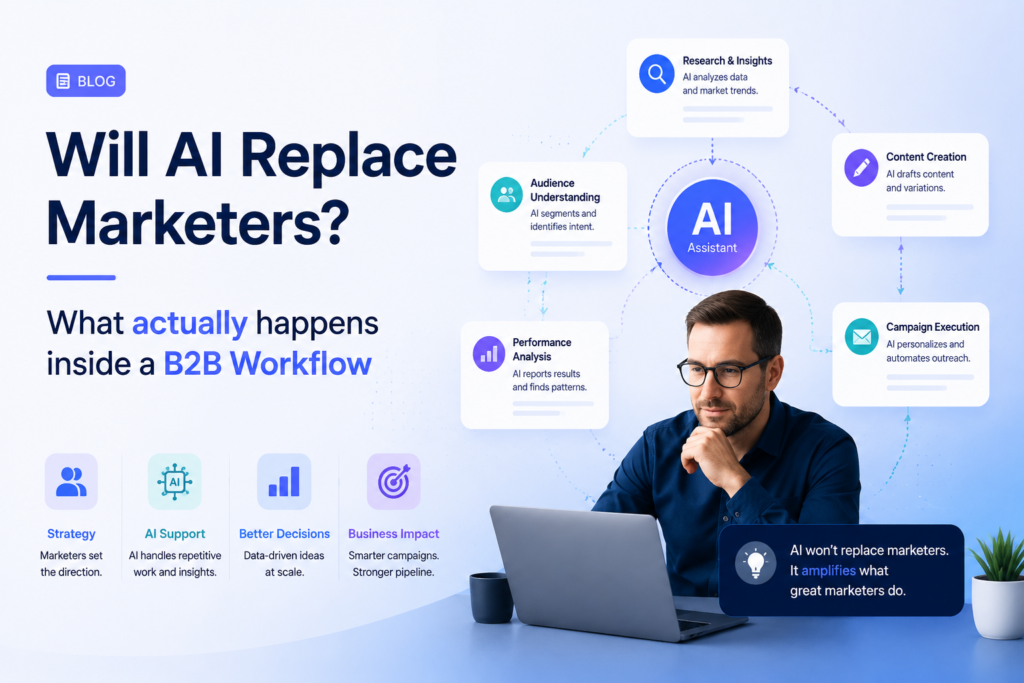
Predictive analytics. This is the one that has the clearest and most straightforward value. Give a model the recorded history of your closed-won and closed-lost deals and it will start to figure out the characteristics of a successful one: company size, tech stack industry how the buyer was first engaged. Then it will give you a ranked list of your accounts so that you can know which 300 out of your 4,000 to focus on this quarter instead of treating them all equally.
The downside that no one in the demo mentions: the model’s intelligence is limited to the quality of your CRM. If your sales everyone mark a lost deal simply with “not a fit” and no other details, then predictive analytics in your B2B funnel is left with nothing useful to learn from. Garbage in equals confident-sounding garbage out. The teams that derive value here first cleaned up their data and admitted that it was a painful process.
Intent data. You can use third-party signals to find out when an account suddenly opens quite a few articles about “data warehouse migration”. This sudden interest is a genuine purchase signal. AI is good at aggregating these signals for thousands of accounts at once. Intent data marketing is effective because it identifies potential buyers before your contact form submissions.
But, a surge in research does not necessarily mean a buyer. It could be someone conducting a research report or a competitor who is looking through your materials. This indicator shows that something is going on but a person is still the one who will decide whether it is worthwhile to send a personalized message, a gentle reminder, or nothing at all.
Lead qualification is one of the first functions that chatbots and routing tools obtain nowadays: they are capable of asking the preliminary questions, arranging the meeting, and even sending the typical “you’re not a fit, here’s a resource” message. With the appropriate use, lead qualification AI can do 60% of inbound that was never going to buy off your SDRs’ plates so the reps can focus on the 40% that are more likely.
Yet, this is where things can get out of hand. A qualification bot is not capable of understanding the subtle doubt in a prospect’s voice. It is unaware that the “small” account raising simple questions is actually a step towards getting a logo that you’ve been after for two years. If you over-automate this part, you will end up burning the relationships that you didn’t even realize existed.
What still needs a human
If you eliminate the elements that are controlled by AI, you will be left with the parts of marketing that are behind the decision whether a deal will be closed or not.
Judgment when the data is thin or contradictory. The model gives you a number; you still have to decide whether to trust it this time. Positioning and story, too. AI can rewrite your messaging fifty ways, but it can’t tell you that your whole category is about to shift and you should plant a flag now. Relationships, which in B2B run on six-month sales cycles and a lot of “let me check with my team.” And accountability. When the quarter misses, no one wants to hear that the algorithm did its best.
And then there is flavor which seems like a nice-to-have until you’ve observed two competitors releasing nearly identical AI-generated blog posts in the same week. A human who can tell when something sounds like everybody else’s will be incredibly valuable at present.
The system that genuinely functions
The people who are getting results are not those who convinced themselves not to use AI, nor they are the ones who have completely surrendered control to it. They have developed a well-defined transition boundary. It clogs this components:
- AI is responsible for the initial filtering: evaluating accounts, categorizing inbound, transcription of call notes, creating the first draft of the email.
- Before any of these processes are carried out, a human must determine the plan and the limits. What type of accounts are desirable? What do we believe in? Which tasks are never going to be automated?
- A person checks outlier situations and overrides the model when something appears to be wrong.
- Results get incorporated. Reps enter reasons why deals won or lost, so the predictive model and the qualification logic get sharper over time.
Most teams skip that last step, and it’s really what separates a model that keeps getting better from one that just gradually turns into nonsense without anyone noticing.
Just a few genuine warnings
Blindly trusting the score is by far the most common mistake I notice. The “92” right next to an account looks like it’s objective. Actually, it’s not. It’s a well-mathematically-supported guess.
Automating the human aspect before it is really ready is the second biggest mistake. It’s great to have speed at the top of the funnel unless you’ve automatically eliminated your next big customer without even realizing.
And letting AI be your only content writer will, after some time, make your brand sound exactly like all the other brands that use the same tools. You can use it to speed up the production of a first draft but then you make it sound like you.
So, are you going to be replaced?
Not if you ever brought judgment, positioning, and relationship-building to the table as your value proposition. Those marketers who’ll find themselves in trouble are the ones whose entire contribution was the very task that AI now does in seconds. Those who’ll do really well are mastering a new skill: figuring out what to delegate to the machine and what to keep on their own desk.
At Oxper, when we do demand generation and ABM programs, we see that as the exact dividing line. The AI does the sorting and the scoring. The deciding on strategy, positioning, and making the judgment calls are human things. That division isn’t a second best. It’s actually the main point.
AI is like a super fast junior analyst who never needs rest and never argues. Sometimes useful, sometimes brilliant, sometimes confidently wrong. But a person still needs to lead the team. And that person is you.
FAQs
Are marketing jobs going to be replaced by AI?
Only parts of the job, not the entire role. So, if most of your time is spent sorting lists and writing first-draft emails, you’ll likely see this part of your role shrink. Then again, if you’re the one doing strategy, positioning, and building the relationships behind the deal, then AI is mostly giving you back your time. The people who will have a hard time are those who never even tried to move beyond the basics.
As a B2B marketing department, what marketing tasks should we be automating first?
Touch on the areas where there is a high-volume of work but low need for judgment: account scoring and ranking, triaging inbound leads, writing call notes summaries, and producing initial drafts. That’s where AI can save you a lot of hours with minimal risk. Avoid anything that involves direct buyer relationships until you have trusted the other areas.
Does predictive analytics make sense for a smaller B2B company?
It only makes sense if you have enough clean historical data to train the system. Training any model on a few hundred unclean and half-logged deals will lead to you getting very confidently wrong results. So first of all, if your CRM data is not good, make it good and only then come back to predictive scoring when you have real, consistent records of wins and losses to supply it.
How does intent data differ from lead scoring?
Lead scoring analyzes your internal data to find out which accounts are the best fit and most likely to make a purchase. Intent data comes from outside your sales funnel, detecting signals that an account is currently researching your product category. One shows you who would make a good customer; the other shows you who is interested this week. Together, they are more effective than each one separately.
Could AI be the one to qualify leads entirely?
For the most obvious cases, the answer is yes. A qualification bot can ask the most basic questions, schedule meetings, and eliminate the clearly unsuitable prospects. Still, it is wise to involve a human in any cases which are ambiguous or of high value. A bot cannot detect a person’s hesitation during a call or recognize that a small account is the key to a much bigger one for you.