

A marketing director at a mid-size software company told me last month that she kind of stopped looking up vendor comparisons on Google. She starts by putting her question in ChatGPT, then reads the response and only clicks on one or maybe a few sources if she feels the info should be rechecked. And no, she isn’t an unusual case. Basically her whole buying committee does the same pattern now.
The reason for this shift is the existence of answer engine optimization. The question has been changed so quietly that for roughly twenty years the goal was to rank, earn the click, and then win the visit. Still, the buyer can now get a full comparison, a shortlist, and even a recommendation without visiting anyone at all. So the new question is both easier and harder, depending on how you view it: when an AI helper answers your buyer’s question, is your company actually included in that answer, or are you basically absent from it?
What is AEO really?
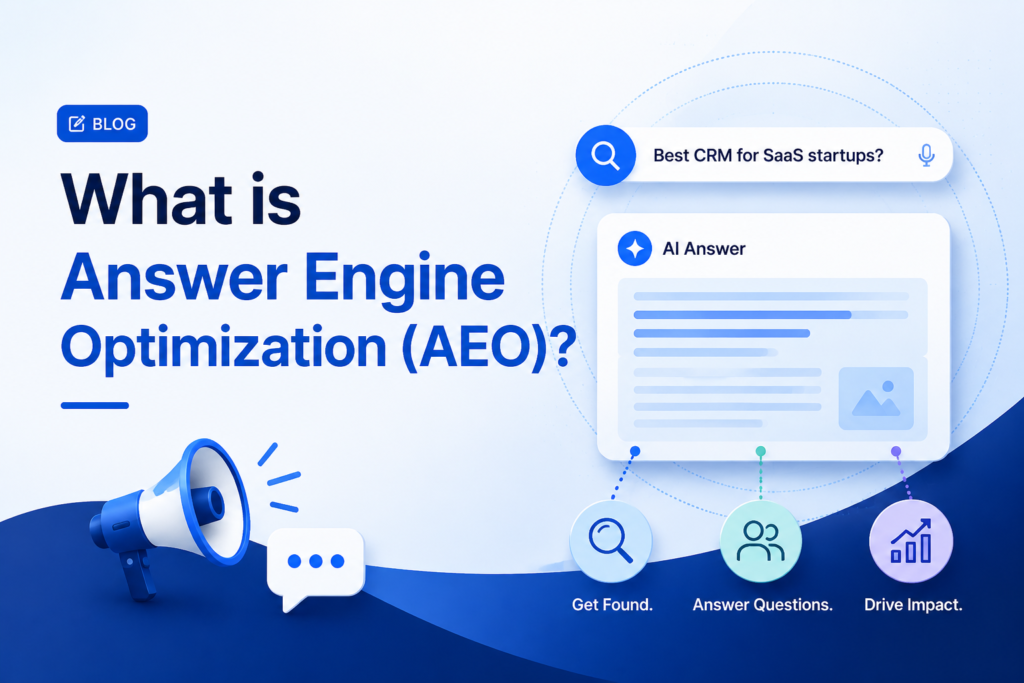
Answer engine optimization is mostly about helping your content become recognized, trusted, and cited by AI systems that directly respond to questions. For example ChatGPT, Perplexity, Google’s AI Overviews, and the AI search parts that are now embedded in many assistant experiences. You might also hear it called AI optimization (AIO), and it’s closely tied to generative engine optimization (GEO), a term a Princeton research group introduced in 2023. Honestly, the names don’t differ that much. The core aim is: being the source the machine chooses.
The biggest mental adjustment is the key part. With normal search, a person sees a list, then decides. An answer engine instead checks multiple sources, pulls out the sections it considers most fitting and reliable, then merges that into one reply. The contest isn’t primarily over a blue link anymore. It’s over
AEO vs SEO: Where They Part Ways
People often wonder if AEO is going to take over from SEO. The answer is no. Actually, it is like SEO has taken a second gig alongside the first one.
What follows is probably the most straightforward way I could put the distinction. SEO means getting a good ranking and the click. You want to be in the first position on the results page so that a person picks you. AEO means being retrieved and cited. You need an AI to locate your exact piece of text, to decide it is the right one, and to use it even when the user never comes to your website.
This implies something:
SEO values a whole page. AEO values a passage. Answer engines are not going to extract entire articles; they will only take the bit that brings the answer. If your major point is hidden in paragraph nine after a long lead-up, the AI might never see it.
In general SEO accepts a certain amount of ambiguity. But, AEO takes, or at least expects, clear and precise answers. Where a human would understand a clever headline and deduce its meaning, a model wants the claim to be explicitly stated early on and in language that it can lift directly without having to guess.
Where SEO accomplishment is measured in the volume of visitors, AEO accomplishment is more likely to be measured in the kind of influence that disappears from your analytics when the buyer seems to have got their answer and doesn’t click. And that last point is the very one that throws B2B teams off, so it’s worth thinking about it.
The good part: these two actually complement each other. The very factors that make content simple for a model to fetch, like a nice layout, genuine knowledge, straightforward answers, should help with standard rankings as well. You aren’t playing as two different rulebooks. You are simply lifting the veil.
Reasons Why B2B Should Pay More Attention Than Others
In B2B, the buyer independently does a large part of the research work even before, at least, talking with your sales team. They are scoping the category, making a shortlist, and forming opinions all in private. It used to be that such research was conducted through numerous browser tabs. Much of it is now done through an AI chat.
If the procurement lead directs the question to an assistant “what are the best account-based marketing platforms for a 50-person sales team, ” the answer it generates is what becomes their initial understanding. The vendors that get mentioned finally get considered. The ones that are left out generally won’t be looked at again since the buyers will not even know their existence. There will be no impression, no click, no line in your dashboard. In fact, you just simply were not in the room.
This explains why AEO is even more crucial to considered, high-ticket B2B purchases than, for example, a quick consumer lookup. The absences here are much more pointed, and then there is In reality the buying committee is larger. That’s why, the AI’s answer gets to be sent around and repeated. A single omission can silently lead to your losing a deal that you were even unaware of the existence of.
How Answer Engines Really Decide What to Index
You don’t have to be a professional engineer to comprehend this, but having a general understanding will allow you to make better decisions.
Most of the these machines perform retrieval first and only then generate. Simply put: if a question is asked, the engine will search through the content, identify the passages that are most likely relevant, and provide those to the language model to compose the answer. Your content needs to meet two criteria. One is that it should be easy to locate and the parts should be able to be isolated, i.e. structured in such a way that a relevant passage can be extracted on its own. The other is that it should be of such quality as to instill trust, as the model is in essence making a quick assessment whether your claim ought to be included in the answer.
Credibility here leverages heavily Google’s E-E-A-T: experience expertise authoritativeness, trust. Genuine authorship, particular claims, consistent information about your identity online and references on source that the search engine already trusts all contribute to that assessment.
Consistency of identity is something that matters more than people realize. If the AI doesn’t manage to figure out “who this company is and what do they do”, it more often than not leaves you out instead of being wrong.
What to Actually Do About It
You do not have to change your entire content operation from scratch. Most of the effects come from few moves.
Answer the question in the first breath. Put the direct answer at the top of the page or section, in one or two clean sentences, then expand. This single change does more for retrieval than almost anything else, because the model can grab a complete answer without hunting.
Write around real questions, not just keywords. Pull the actual phrasing your buyers use, the messy, specific ones, and answer each one cleanly under its own heading. “How is ABM different from demand generation” is a better target than the keyword “ABM.”
Build a real and deep understanding of the topics that you want to be recognized for. Answer engines reward sources that deal with a given topic in a detailed and precise way, not those with thin pages overloaded with keywords. Select the questions that you can answer best and invest in these.
Earn mentions just for being yourself. Being cited, quoted, or accurately described on sites that the engine already trusts is one of the most powerful authority signals you can develop. This is where digital PR, expert contributions, and yes, well-placed guest content truly result in success.
Keep your entity information consistent and add structured data where it fits. Be sure that your company name, description of what you do, and your important details are the same across your website, your social media profiles, and third-party listings. Schema markup is used for machines to differentiate what a question, answer, and product are.
Measure differently. Stop judging this purely on clicks. Run your priority questions through ChatGPT, Perplexity, and Google’s AI mode on a schedule, and track whether you show up and how you’re described. A few tools now monitor this, but doing it by hand monthly already tells you a lot.
That is the moment when many teams discover that AEO is not a separate SEO task but rather a question of the sales funnel. The demand generation and account-based marketing teams I collaborate with at Oxper are beginning to view AI visibility as a top-of-the-funnel channel, similar to other channels, with designated owners, targets, and a feedback loop into sales.
FAQs
Is AEO going to replace SEO?
Not at all. AEO is a new feature that gets added on top of good SEO. Your basic skills like having pretty website layouts, being an actual thought-leader in your area and having really accurate content are your best weapons for AI citing as well. It would be unwise to cut down your SEO work just for chasing after AEO.
Will AEO give me traffic?
Either yes or no. AI-derived responses frequently answer a buyer’s question without a visit so that the value comes partly from influence rather than visits. Being on shortlists and influencing the way buyers think about the category, although harder to measure, is very real in long B2B cycles.
Which answer engines should a B2B company focus on?
Be where your buyers are. For most B2B audiences, that means ChatGPT, Perplexity, and Google’s AI Overviews. Find out which ones your specific buyers actually use, then prioritize.
Do I need schema markup for AEO?
It does help but it is not the switch that solves all your problems. Structured data makes it easier for systems to understand your content, Mostly FAQs and product details. But, clear writing and a direct answer up front usually matter more, so fix those first.
How do I know if AEO is working?
Regularly put your main buyer questions through most major AI tools to check if you appear and how accurately you are described. That monitoring, combined with any referral traffic coming from AI sources, gives you with tangible insights.